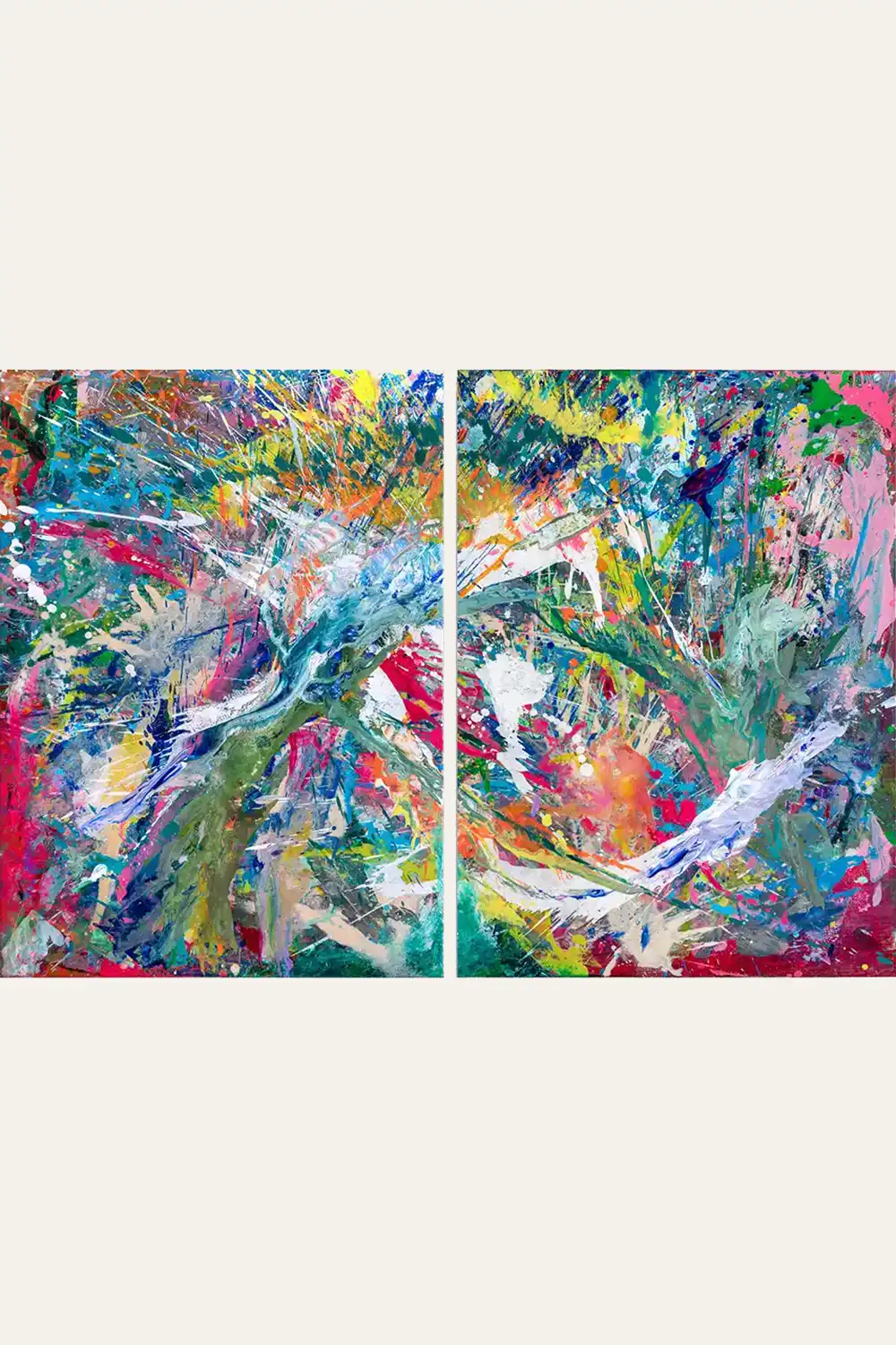
There is a moment in many interior projects when the room is almost finished. The furniture is placed. The lighting is set. The palette is coherent. And yet something is missing. Not an object. A weight. The space feels like a sentence without a period.
This can be the moment to consider abstract art—not simply to decorate, but to anchor.
Decoration vs. Anchor
Decoration fills a gap. An anchor creates a center. When a designer places a painting above a sofa or at the end of a corridor, they are not looking for something “nice.” They are looking for something that makes the rest of the room make sense. The painting becomes the point around which the furniture orbits. Without it, the room drifts.
Pieces from the Muscle Memory series can operate in this way. The red forms do not match the cushions. They do not echo the rug. They stand in opposition to them, and that opposition is what gives the room its spine. A neutral space with a bold abstract canvas is not a contrast. It is a dialogue.
The Light Test
It can be useful to test a painting at three times of day. Morning light, afternoon glare, evening lamplight. Abstract work changes with each. The epoxy surface in my paintings catches light differently than matte canvas — it holds a glow in the morning and releases it slowly in the evening. This means the painting is not a static object. It is a timekeeper.
Planning for art early can leave walls intentionally open for the piece that will claim them.
Negative Space as Collaboration
An interior can leave room for the art to breathe. A common mistake is to fill every wall. But abstract painting, especially large-scale work, needs distance. It needs to be seen from across the room, not just up close. The Emotional Big Bang pieces, at 100 x 81 cm and above, were made with this distance in mind. They are not details to be inspected. They are presences to be felt.
When a designer gives a painting that much space, the painting returns the favor. It holds the room together.
For the Designer at the Drawing Board
If you are working on a project and feeling that the space lacks gravity, consider whether the problem is furniture and whether it is silence. Sometimes a room does not need more design. It needs a voice.
Questions about scale, placement, lighting, current work, and studio images can be discussed directly.
Explore the Muscle Memory series · View selected works · Inquire for projects